Why Authorisation Must Be Designed, Not Bolted On - With OpenFGA

Author – Kalana Jayasuriya, Software Engineer
Read time 5mts (word count 1,235)
As enterprises modernise their digital platforms, enterprise security is entering a new failure point - not authentication, but authorisation.
Authorisation logic is often deeply embedded inside applications, duplicated across services, and tightly coupled to business rules that change constantly. As systems scale across cloud platforms, internal tools, partner integrations, and increasingly AI-driven workflows this approach becomes difficult to govern, costly to maintain, and risky to extend.
In most organisations, access decisions span multiple systems such as collaboration tools, data platforms, CRMs, internal APIs, and line-of-business applications. While authentication is usually centralised, authorisation is frequently hard-coded, inconsistent, or implemented differently in every application. This creates a growing risk of;
What's needed is a decoupled, fine-grained authorisation model that can express real-world relationships, evaluate access at runtime, and scale without forcing organisations into large, upfront platform investments.
This is where Relationship-based Access Graphs combined with Fine-Grained Authorisation (FGA) become critical. In this article, we explore how this model works in practice - and how open-source platforms like OpenFGA can deliver enterprise-grade security outcomes without the overhead of heavyweight, proprietary authorisation stacks.
As an open-source, production-ready fine-grained authorisation platform, OpenFGA enables enterprises to externalise and centralise access control. It allows organisations to model real-world relationships, evaluate access dynamically at runtime, and scale authorisation independently of application code.
In this article, we explore why relationship-based access control is becoming essential at enterprise scale and how OpenFGA provides a secure, flexible, and cost-effective foundation for modern authorisation, especially in an era of AI-driven systems and rapidly evolving business models.
For organisations looking to modernise identity and access control without unnecessary cost or complexity, this approach offers a practical, future-proof path forward.
As enterprises grow more complex, access control is no more just a technical implementation detail it becomes a core governance and risk concern.
Modern organisations are fluid by design. Teams form around initiatives rather than fixed functions. External partners, vendors, and platforms require controlled access to shared systems. AI-driven workflows increasingly act on behalf of users. Yet many access models still assume static organisational charts and long-lived roles. This disconnect is where risk accumulates.
When access is defined primarily by ‘who someone is’ rather than ‘how they are connected to systems and data’, organisations are forced into trade-offs. To maintain speed, users are often over-permissioned. To maintain control, delivery slows as every organisational change requires reworking access logic. Over time, this creates brittle systems that are expensive to govern and difficult to evolve safely.
What’s needed is a way to express access in terms that reflect how enterprises actually operate dynamically, contextually, and at scale. This level of precision is critical in preventing over-permissioning, one of the leading causes of enterprise data exposure.
Relationship-based Access Graph and FGA are not separate ideas. They are co-existing with each other. Relationship-based Access Graph describes relationships, while FGA evaluates relationships at runtime. Without a Relationship-based Access Graph, FGA needs complex or hard-coded logic to make decisions. Without FGA, the Relationship-based Access Graph cannot create meaningful access control by itself.
While all the business logic can stay in your system, you can move your Authorisation logic into an external and standard place.
OpenFGA is an open source authorisation engine that implements the Relationship-based Access Graph model to deliver Fine-Grain Authorisation (FGA). OpenFGA can provide a centralised, consistent way to define relationships and evaluate access decisions to multiple applications at once.
As an open source authorisation engine, OpenFGA answers all the burning problems currently in the industry. It is already
Assume you are implementing an AI model to connect with your Confluence. Now users can ask questions to AI, and AI can go through all the resources in your Confluence.
Problem -: If a normal user requests a detail that belongs to an admin user or a restricted page, the AI model can retrieve that data for that normal user. We need to prevent that from happening
Answer -: OpenFGA
How to do that?
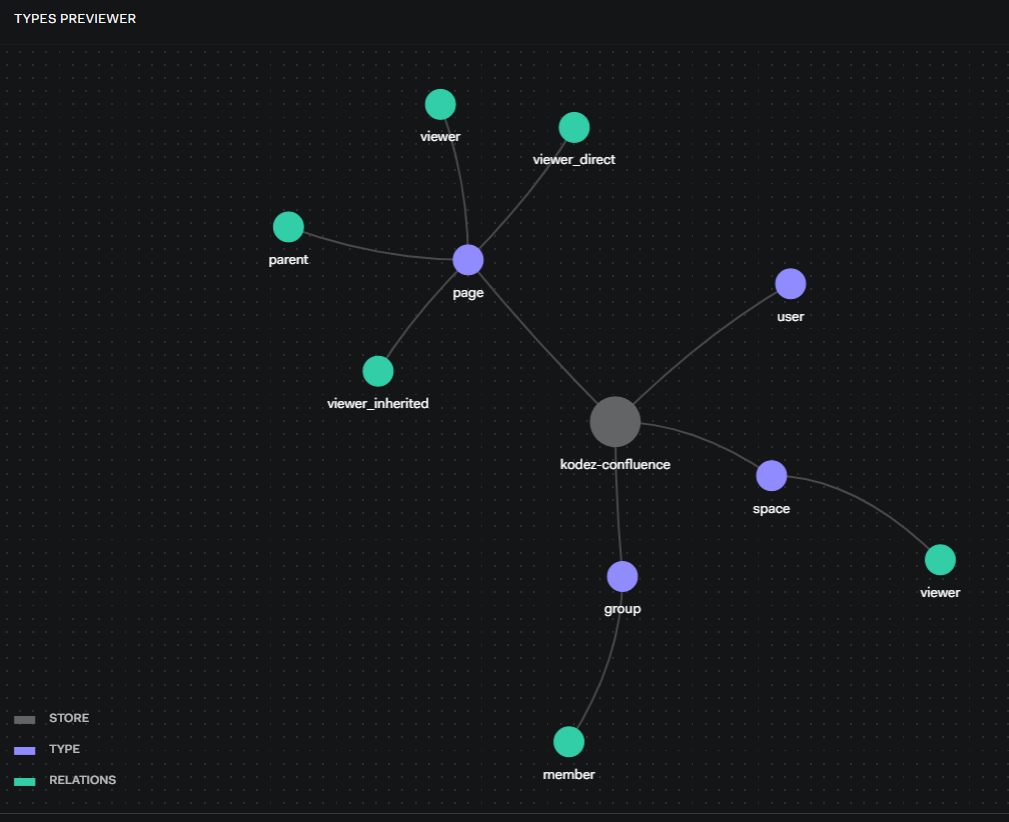
When we build the OpenFGA model for Confluence, we consider four entities.
These four entities have the following relations
We have applied these logics internally, and the diagram below describes the above logics
%20(1).png)
To support this, we need to create a matching authorization Model. Let’s discuss this step by step.
type usertype group
relations
define member: [user]type space
relations
define viewer: [user, group#member]type page
relations
define parent: [space]
define viewer: viewer_direct and viewer_inherited
define viewer_direct: [user, group#member]
define viewer_inherited: viewer from parentparent: [space] -: A page has a parent space.viewer_direct: [user, group#member] -: A page can be viewed directly by a user or a group member.model
schema 1.1
type user
type group
  relations
    define member: [user]
type space
  relations
    define viewer: [user, group#member]
type page
  relations
    define parent: [space]
    define viewer: viewer_direct and viewer_inherited
    define viewer_direct: [user, group#member]
    define viewer_inherited: viewer from parent
const fga = new OpenFgaClient({
  apiUrl: process.env.FGA_API_URL,
  storeId: process.env.STORE_ID,
});

const writeTuples = async () => {
  await fga.write({
    writes: [
      // Assign roles
      { user: 'user:Kalana', relation: 'viewer', object: 'role:admin' },
      { user: 'user:Dilan', relation: 'viewer', object: 'role:member' },

      // Role's readers granted access to pages
      { user: 'role:admin#reader', relation: 'viewer_direct', object: 'page:Restricted_Page' },
      { user: 'role:admin#reader', relation: 'viewer_direct', object: 'page:Page_Details' },
      { user: 'role:member#reader', relation: 'viewer_direct', object: 'page:Page_Details' },
    ],
  });
};

writeTuples();const fga = new OpenFgaClient({
apiUrl: process.env.FGA_API_URL,
storeId: process.env.STORE_ID,
});
const checkAccess = async (user, page) => {
const result = await fga.check({
user: `user:${user}`,
relation: 'viewer_direct',
object: `page:${page}`,
});
console.log(`${user} can view ${page}: ${result.allowed ? 'Yes' : 'No'}`);
};
(async () => {
await checkAccess('Kalana', 'Restricted_Page');
await checkAccess('Dilan', 'Restricted_Page');
await checkAccess('Kalana', 'Page_Details');
await checkAccess('Dilan', 'Page_Details');
})();Kalana can view Restricted_Page: Yes
Dilan can view Restricted_Page: No <---- check success
Kalana can view Page_Details: Yes
Dilan can view Page_Details: Yes
For enterprise technology leaders, authorisation is no longer a purely technical concern, it is a governance, risk, and scalability challenge.
As organisations expand across platforms, partners, and AI-enabled services, access decisions must be precise, auditable, and adaptable to constant change. Hard-coded rules, fragmented policies, and proprietary platforms make this harder, not easier to achieve.
OpenFGA demonstrates that enterprise-grade authorisation does not need to come with enterprise lock-in. By separating access control from application logic and modelling permissions through relationships rather than static roles, OpenFGA enables to;
Perhaps most importantly, OpenFGA aligns with how modern enterprises actually operate where people, services, data, and AI systems are connected through dynamic relationships that change over time.
As organisations reassess their security architecture for the next phase of growth, open, relationship-based authorisation is becoming a strategic requirement. OpenFGA offers a practical, proven way to meet that requirement without sacrificing flexibility, transparency, or control.
At Kodez, we help enterprises design and implement identity-led authorisation architectures that scale across cloud platforms, internal systems, and AI-powered applications. Whether integrating OpenFGA, Auth0, or modern cloud identity platforms, our focus is ensuring security, delivery velocity, and governance evolve together.
Get to know us better and to see what we've been doing recently
.png)